S4 · E2 · Now on YouTube
She wasn’tmy pick.
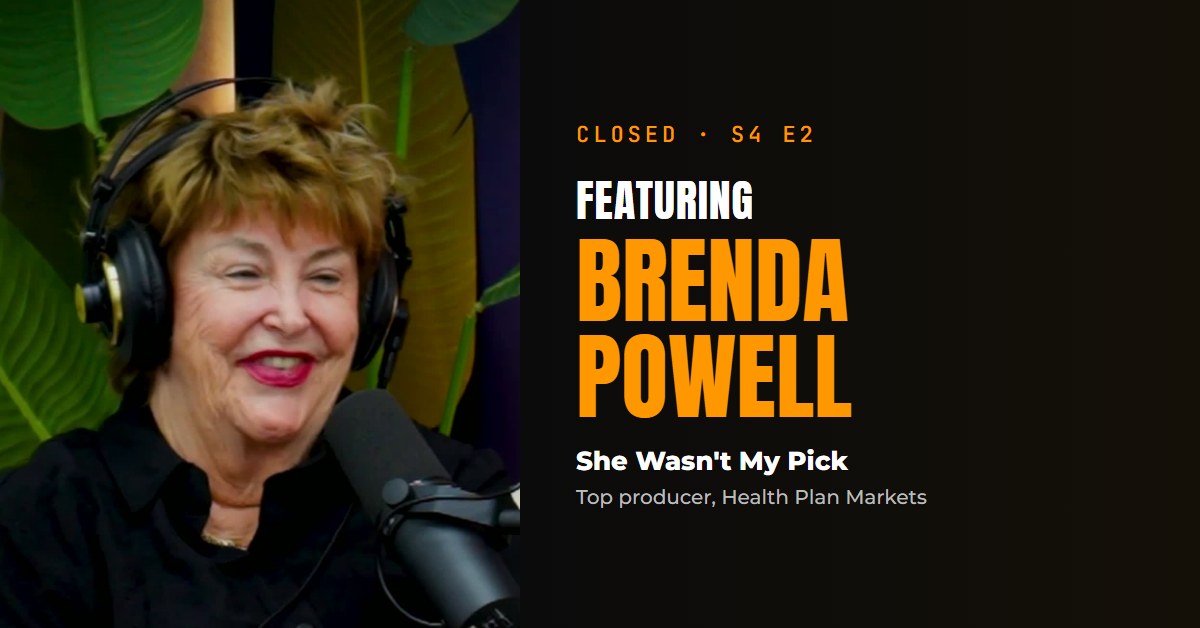
Brenda PowellTop producer, Health Plan MarketsThe best bet in the room
Two new agents sat down at Justin’s table on the same day. One did all the talking. Brenda Powell sat quiet, watching and listening. Justin bet on the talker.
Brenda had never sold health insurance. She was close to losing her home and working a job she hated. The other agent left the business. Brenda became one of HPM’s top producers.
If you’re the quiet one at the table, this episode is for you. Brenda’s edge was how well she listened.
Watch on YouTube“So the way I look at it, the less I talk to them, the more they come back to me.”
 Watch on YouTube ▶
Section 2 of 5 · Jump in anywhere
Chapters
Times from the published episode.
- 0:00Cold open
- 0:28Welcome to Closed
- 0:47Two agents, one table, the wrong bet
- 2:08Green in Medicare, but she knew how to sell
- 4:02Sitting by the baskets at Publix
- 6:08What nobody else saw
- 7:29From agent to family
- 9:51Listen first, then teach
- 13:31Her phone goes with her
- 15:38Her own office
- 17:50Chasing clients vs being there
- 20:47How she earns trust
- 25:24To the agent nobody bet on
- 29:46Get a mentor early
- 32:51The best bet in the room
Section 3 of 5 · The lesson
Six moves to steal
How a green agent became the one clients call family.
- 1
Compete only with yourself.
She never measured herself against the veterans with 2,000 clients. In her words, “the only person I had to compete with, and that’s myself.”
- 2
Ask for your own spot.
Her first year, she walked up to two Publix managers on her own and asked to sit by the baskets. That table gave her 14 appointments.
- 3
Listen before you teach.
Every first appointment opens the same way: “Well, tell me what’s going on in your life.” She listens for 15 to 20 minutes before Medicare comes up.
- 4
Talk less.
Pushing turns people off, and they leave on the back side. When she’s relaxed, they relax, and they come back.
- 5
Call back the same day.
She answers every call and returns it that day, even at 8 o’clock at night. “I want you to know I wasn’t gonna let this day go by without giving you a call.”
- 6
Get a mentor early.
Victor went with her on her first appointment. Years later, she still calls him to talk through what she’s doing.
“Compete with only yourself and build knowledge, because knowledge is power.”
Section 4 of 5 · Use it this week
The toolkit
Two sheets to print, the weekly rhythm, and her line on talking less.
- MondayBook one place to be seen this week: a store table, a church event, a community talk.
- Every dayReturn every call the same day. Hand your card to whoever you’re talking to.
- Every new clientLet them tell you their life first. Medicare comes second.
- FridayMake your 30, 60 and 90 day calls. Ask how the policy is going.
Section 5 of 5 · Every word
The transcript
A machine transcript of the conversation, lightly corrected.
Read the full conversation
When Brenda Powell walked in, I bet on the other agent. Brenda had never sold health insurance a day in her life. The other one had experience, and she's the one who left the business. Brenda, she's one of our top producers now. Turns out the woman who makes clients feel like family was the best bet in the room the whole time. Let's go. I am here with Brenda Powell, one of our top producers here at Health Plan Markets. Thank you very much for coming. I know we had to track you down.
I'm always busy. To get you here. And thank you for allowing me to come over and do this with you today. No, it's been amazing. And we've had an amazing partnership. Absolutely. But I will say at the beginning, which started at the beginning, I remember the day that you came in, and I can't remember how we hooked up, but there was two of you. So you both came in at the same time and we're sitting at the table and it was you and it was another agent and we won't mention her name, but I'll be honest with you, I said, I said, "She's not gonna make it." I don't know why, but for some reason in my head, I said, "She's not gonna make it." And I thought the other agent was gonna make it and she was gonna be a top producer, but it all turned out the exact opposite.
And to this day, I use that example as never judge a book by their cover 'cause you really don't know. So you've helped me with that lesson, but. I was very quiet. She did all the talking. That's true. Okay. That is true. And I had just retired not too long ago from Liberty Mutual. And so I had already hooked up with another agency and it wasn't going anywhere. Yeah. And so when we came to meet you, everything was all new to me. So I was observing and gathering information because I was kind of distraught because of all the money that had sunk in at the other agency and then nothing was happening and no training.
Yeah, so what made you try health insurance? 'Cause you were coming out of life insurance and into health insurance. Well, I was an old life insurance agent out in the field. Okay, I always say old 'cause it's been years ago. And then I was a top producer there and I used to go door to door. I used to do, I mean, everything you could think of, because there was, it was no holes bar when it came to life insurance. So I decided to go to work for Liberty Mutual and get my P&C license.
Did very well with them. I sold 110,000 a month. Wow. Yeah. I was with them for years and years and years. So when I knew I was getting closer to Medicare age myself, I decided that I wanted to get it and learn about Medicare. Didn't know a thing about it, but I knew how to sell. I've always known how to sell. I mean, being in a call center for years. But it rounded me out on how to work with people face-to-face and even on the phone.
So, when I got into hooking up with your agency, I started off with it and... Fresh. Fresh, and so I met my mentor, Victor. He helped me to pass the... Came into your office, 'cause we used to all do that at your colonial office and get all the tests, and I was only appointed with Humana. So that's what I went with. And so I always knew that being in sales, the only person I had to compete with, and that's myself. I love that. Yeah. And so that first year, I went to two managers at Publix on my own and asked them if I could sit by the baskets to just get them to fill out a scope and make an appointment.
That's amazing. And I did it at both of the different Publix, and guess who came walking in the door? Lynn from Humana, and she says, "How did you get the spot?" And I said, "Am I in trouble?" He says, "No, you're not in trouble? This is wonderful, and you got the right banner." I said, "Well, I got that from my agency. They gave that to me." at Health Plan Markets. And she says, hold on. She says, I got to go out to my car. She brought me a bag of trinkets and she gave me a Humana fold up with the zipper notebook.
That's amazing. Yeah, and so I had gotten 14 appointments and Victor went with me on my first one. Okay, okay. And I thought I can do this. And I wrote every policy electronically that point on. Great. And so what happened is that, "Hey, I can do this. I can do this. I can do this." And then what happened after AEP was over with and I saw the money that they dumped into my account, I thought, "I can do this." Okay? That motivated me to continue. And then I met Deb Becker at UnitedHealthcare.
And she said one thing to me, because she was giving a training in Daytona, and she says, "You don't know much about Medicare." I said, "Well, I passed the A-HIP, and I passed Humana, and I just wrote 14 policies with them." She said, "Well, you need to change those over to United." And I just looked at it and I said, "Oh." So she continued on training me, besides talking with Victor. And then she got me into a Walgreens, and it didn't stop after that. Yeah. Yeah.
You've been like a machine on there. So in the beginning, what did you have in the beginning that nobody else really saw? You talked about you knowing how to sell, but was there anything else there? My own motivation because I was financially not doing well. I was about to lose my home and I was keeping up. I was on the edge. And when I saw how much money was put into my account, and I was only doing this on the weekend, because I was working another job.
And I hated that job. I hated it with a purple passion. And I knew that this was going to be the ball of wax for me to mold and to grow and to learn and to associate with people and to earn friends with the knowledge that I was going to get with Medicare. And you knew I was really great. Oh, yeah. I was so green. And so from this day, even though she's no longer in the industry, she will call me and apologize. Like, you know, I should have never said that to you because I've never seen a person that took off with it as much as you did.
Exactly. And I said, well, I said, it's been a great journey. Yeah. And I'll do it until I take my last breath. Yeah, I love that. And you've really built a following, you know, your book of business, your clients, and the way that they don't just see you as an agent now, like you've been called sister, their advisor, you know, you're kind of like part of the family now. So when did that happen? And I guess like when did you realize that you've become more than just the agent?
Well, you know, building the first year and learning and then, you know, signing up, getting appointed with all the other insurance companies and just building knowledge. So when someone comes and sees me, and I get a lot of referrals now, okay, we heard about you, you know, because I go the extra mile. So when I was at Walgreens, it put me into Medicaid, because there was a lot of beneficiaries that were coming in, so I'm on Medicaid and this and that. And so I taught myself how to do the application and just kept building up from there.
And I did five, and I thought to myself, "Well, goodness, if I just do this all the time, I'm not gonna be able to make a living." And then all of a sudden, they were approved, and I wrote the policies. I thought, "This is nice. This is really nice." So I kept building, and then also UnitedHealthcare connected with me with the homeless shelter that's in the land and paid $5,000 for me to be there every day, four to five hours. So I was a caseworker for them for four and a half years.
And I did food stamps, I did the Medicare savings program, I got into doing long-term care, and it just built and built and built, and so the trust factor, the calling me for information and asking me for this and this, because they knew my heart went out to them to help them. And so the trust factor built and built and built, and then doing a lot of events and just meeting a lot of people and doing the telethon, it just, everything, I don't want to say, it gradually opened up with an explosion.
Yeah. And I think people, you know, it's easy to say people want to be heard, right? It's easy to say that, but why do most agents get that wrong or they're terrible at it? Well, I think just being a woman is, you know, we take things more to heart, we're nurturers. Okay. And so when someone sits in front of me, I don't get an aggressiveness of trying to make a sale, I am there to educate. So, when I sit with someone new, and they come in, and I said, "Well, tell me what's going on in your life.
What's happening now that you're getting to the age to age into Medicare?" I said, "What, you know, what has been confronted with you? Brenda, I don't know what's happening." And I said, "Well, let me listen to more of a needs analysis, so I can help you where you're at in your life. If you feel like you're in a financial bind, if you're low income, what else? So I can understand where you're coming from. And so my mind is going like crazy when I'm listening to their lifestyle and what's going on with their health, because they want to tell you everything.
And so after about 15, 20 minutes, I'll tell them, I said, "So let's learn about Medicare." And then I will teach you as much as I know, because I always say there's two avenues, you know, and I'll understand where you're coming at in your life with what's going to help you with the next phase of your life being in Medicare. Right. And so by the time I get through with them after a couple hours, then they have an understanding of which way they're going to go.
And so I will sit with them, I said, "Look, financially you're having a problem and you've got health problems, well, then there's the C-SNPs, the chronic C-SNPs." So by the time I listen to them and do a needs analysis and help them to understand where they are and what they've got to do to get their Medicare number, that's the first step. I said, "I can't help you until you get that." And then when it comes time to writing their policy, I will introduce them to the Hospital Indemnity Plan because it's a necessity to have, to help with all the co-pays.
Yeah, the co-pays, yeah. Yeah. So you're looking at it from the initial sale for the major medical, you know, Medicare Advantage most of the time, and then you're hooking up that hospital indemnity in one, you're doing it in one fell swoop. Are you doing it that way or are you kind of coming back to it? Well, you really can't do it in one, I mean, I initially educate them on that. But the way UnitedHealthcare has it set up, you cannot write it until there's an act of policy.
Got it. So a lot of them will come back, because I'll give them the quote. I will go individually, what is the coverages for everything, how it takes 45 days to put the application and to get a case number and everything, because I learned that the hard way. Got it. What happens is that they come back and some of them, because they're not new to Medicare, they'll come back because they heard about me and were they're paying close to $200 for that hospital indemnity plan because they see it's a necessity.
And they really come through UnitedHealthcare when it comes to that. So since I've had the office, I opened up the office about a year ago And it has been phenomenal. That's awesome. I have people come walking in, they see my sign, I help 'em in all different directions. So talking about that, going back to landing that Publix, and you've been in other places like Walgreens, Walmart, what does that teach you that you can't learn just sitting at the office waiting for your phone to ring? Well, I don't wait for it to ring.
Yeah, yeah, that's a first thing. My phone goes with me wherever I go. So, the thing about it is, is to build rapport. When I sat at the table at Walmart, and you know I did very well during OEP, January, February, March, and if you strike up a conversation, "Oh, I love that blouse you have on it. It goes with your eyes. I love the flowers in your blouse," or you strike up a conversation, want compliments all the time. And by doing that, they're going to feel more comfortable with you.
And so I've learned that no matter where I'm at, if I'm standing in line, when COVID happened, and I was waiting to get my shot, I sold a policy right there. And because we're sitting, we had to wait an hour. And so she says, you know, I need a policy. I just moved down I said, "Oh, wonderful." I said, "I've got my laptop on me. Let's take a look." There you go. So no matter where I go, I'm always handing out cards. Yeah, yeah. I'm striking up conversations.
Not because I want it to be everything that I do in my life, business orientated. It just comes natural. I just got back from Rome. I made, from Health First, little packets and gave it to everybody with my card so I can count it as an expense, you know. Oh, that's brilliant. And so everything is involved in my life with my business and it just comes naturally. I want to inform and educate people so that their life will be better financially because that's a phase of life a lot of people are not going to be working.
that's right that's right so you have an office now yes and tell me how that can't kind of came about and how that started because not every agent has that opportunity to have their own office and and have a have a space that they call their own well uh three years ago i had back surgery. It was really severe. And six weeks before AEP, and after five weeks, I had to shut it down. Wow. And I was in a CVS. And I thought, "Well, I'll go to people's homes and this and that." So I'm moving, right?
Because you can spend a couple of hours with somebody or more, especially if it's two people that you're listening to. So I decided to look for an office. And my first office was in an all-state. Really? Yeah. Okay. I had a space, and I was bringing in a lot of clients that he could do his P&C because I gave up my P&C license. And it was a good partnership, but then he got a little greedy. Okay. Besides me paying him rent, he wanted me to start selling anciliaries under him as a 1099.
Then Allstate found out, "Oh, you can't do this because we advertise for Medicare, even though they don't push it." So I prayed a lot. I had to go ahead and leave. I was only there three months, and I found another place, and it has been wonderful. And it's right on the main road, and they allowed me to put on both sides of the... of the what do you call it? The marquee, the sign. Yeah, yeah, yeah, the marquee. And I have everything that I do. You need Medicare, doesn't that?
I got everything approved through Sergio. So yeah, so I made sure everything was right. And it just has been a wonderful journey and I hope I'm there until I take my last breath. No, I mean, getting a spot is really hard and then you've made it successful 'cause you also have to promote yourself in those locations as well. So you kind of have that traffic built in. What's the difference between chasing clients and being available to them? Okay, so let me tell you, I don't chase clients.
Yeah. That seemed like when I first started out, I was like, ooh! I know, you're-- I was doing events left and right, just to get notice. And so now I connect with businesses. So one is charter research, where they do analysis on testing for dementia, Alzheimer's, and they do many, many other things. So at St. Peter's Catholic Church, I am always doing events there, and elsewhere at other churches, and this and that. And so when somebody is interested and learning about, hey, I could possibly have dementia, right?
So, it's advertised in the bulletin. I put my phone number on there. Nothing to do with Medicare, right? And people call in and they want to come and listen to a speaker that, and it just doesn't have to be with Charter Research, it's with different elder care. Did one with elder care. I do it with different businesses like different nursing homes. And so they come in to listen and yes, I put out a scope of appointment, to see if they're interested. And that's how it builds.
That's amazing. Now you've built a name in your community. Did that happen on purpose or was that kind of, just kind of came with the territory as you're doing what you're doing? It came with the territory, doing events and people. I mean, I was at Walgreens for two years And whenever I was at Walmart, I said, "Weren't you at a Walgreens?" I said, "Yes, I was. Yes, I was. You remember me." And you have to interact with people. And I'm not the type of person that I hardly ever came into the office except to do tests, remember?
So, I don't like being cooped up in office. I love my office, and I write my policies there. I don't go to people's homes anymore, okay? And they come to me. And just the character of having an office and the realization of professionalism has moved up an upper level. So are you getting a lot of business from referrals because of the office, because you're there, because you're available? And because I incorporate everything I do with Medicare, no matter where I go, how I do it, if I'm standing in line, wherever I'm at.
And I strike up a conversation 'cause I make sure I do this. And I said, here's my card. I love that. What's one way, in your opinion, that you can get people to trust you? Well, with the first initial appointment that I have, first thing I do is I have 'em fill out a scope of appointment, right? That's a CMS rule. Oh yeah. And so I listened to what's going on in their lifestyle. And then finally I said, "Let's do a 101 on Medicare." And so before I end up with their appointment, I'm giving them books so that they can take it home and study because I tell them different avenues that you can go with.
And so by the time they're done with the appointment with me, And I said, "So how do you feel now?" Well, I kind of feel overwhelmed. I said, "I don't want you to feel overwhelmed because you can come back and see me again." I said, "And we'll go over the same thing." And I said, "Whatever you do, if somebody calls you, you don't know who that person is on the other side. Don't make that mistake because all they're there to do is to make a sale.
What I've done with you, I've listened to you with your finances and everything to see what road that you need to go on in order to have the right policy for yourself. Yeah, you're building-- Report. Yeah, you're building a report, but you're also educating them, and now you've become a resource. You're not just, oh, this agent's trying to sell me something, I have questions about how this works, and she knows, and she has the resources for me. So the way I look at it, the less I talk to them, the more they come back to me.
Interesting. So if you have that aggressiveness, that's going to turn the person off. Yeah, I've seen agents that are like super aggressive. I'm like, how do these people make sales? And they probably do, but they also have them leave on the backside too. That's right. 'Cause they're like, I don't like this guy. They don't stay. Or girl, whatever. And I'm not saying I've had clients not leave. I mean, yes, they do. And so basically my part is to, help educate. And when they see that I'm relaxed and it helps them to be relaxed and to help them to understand the importance of what they're getting into in the next phrase of their life, they come back and they talk with me.
And they say, "Brenda, you were right. I checked this out. You were right. You were right with this. You were right with that." And that's why I'm back. I say, "Well, that's wonderful. That's wonderful. And I'm here for you." Every call that I get answer. I try to do it on the same day. I don't care how busy I am. I've called clients back at 8 o'clock at night. I said I want you to know I wasn't gonna let this day go by without giving you a call.
What's going on? How can I help you? And that's part of like your reputation, right? That's right. Yeah. That's right. And so that being said, that's how I have built this because they see that I'm here as an advisor to help them to understand what's going on that's going to help them in their life. What do you think they call you sister? Someone call me mama. Okay. I'll admit to it. Not grandma. But you know, there's 65 and ups, you know, but you know, when you get somebody that's on disability and they're on it under the age of 65, you know, I show them all the resources that they need.
Okay, especially what's going to open up in January with, like, it's not Novo, but it's another company in Orange City that's going to help people on long-term care. Oh, amazing. Because now I'm getting clients that are getting dementia, getting Alzheimer's, and they need that in order to help them financially because that saves them, gives them grace of dignity. Yeah. So you're looking at your clients and you're saying, "Okay, you didn't just do a sale. You're actually watching over them and saying there's something new here and because of what you've got, I think this is better for you." That's right.
Yeah. And then I get referrals and referrals and they'll say, "I heard about you." I said, "You did." I love that. I said, "That's wonderful." I said, "I hope it was good." I love it. So, shifting a little bit, you've come a long way. You've been successful in this business early on, you know, maybe nobody put a bet on you. What would you say to an agent that feels that way today, that feels like where Brenda was on day one or day 10? What do you want to say to them?
Well, you always want to get advice, okay? And when you do go on trips, I'd get advice from some other agents on that, but don't compete with yourself with them. Compete with only yourself and build knowledge, because knowledge is power. And the more it settles in with you, and yes, in the beginning, you've got to get out there, you've got to do events, you've got to socialize, you've got to do everything you can to see you have your face out there. And so as you build and you socialize with people doing it as an education, it's going to happen.
It's going to happen. And I knew it would happen for me when I did those 14 sales, my first AEP. I didn't look at any other agent to be intimidated, who had been doing it for a long time, and had 2,000 clients and this and that. I said, well, my goodness, if I ever get 2,000 clients, I hope I can call every one of them back. Because that's the hardest thing to do, is to stay in touch. Yeah, it is. But I'm always wanting to create, to expand, and to help give the knowledge.
Because signing somebody up, and never speaking to them again, you really give a bad reputation-- 100%. --of what it's about being a Medicare agent. Yeah, yeah. And so I know you've expanded in the office. So if somebody helping to do Medicaid, and I look at them and I said, I'm not going to use our services because I'd do it. Yeah, and that's fine. And, you know, some agents are either new to it, so they're not familiar, so they feel better using our service, or they're so jammed up with them and they need help.
That's why we brought it on. But I appreciate that because I-- Well, it helps give resources. Yeah, you don't want them to turn to somebody else. But also, knowing how it works, how the application is, I personally believe you should do it yourself before you, you know, use our service because then you realize how it ticks, what they're needing, you learn the ins and outs of it versus like somebody telling you what it is. Now it's with long-term care because people are aging in and they need help with that.
And I'm excited about this company that's gonna be opening up in January. They're not letting anybody know who they are, that it's going to blow the industry out the door because the land or Volusia County is getting to the point people are having a hard time getting into their doctors. Yeah, yep. And so now you're seeing these different type like with, you know, Advent Health is opening, popping up different offices. This is going to be strictly for people on long-term care. It takes me about an hour and a half to do a long-term care.
But once they open up, they're gonna be able to assist me. Yeah, that's amazing. And I'm excited about that. Yeah. But that's another phase of a person's life. And so, oh, I'm excited to be in this, I wish I would have gotten into it earlier. Yeah. It's a wonderful professional life for even someone who is aging in, and to make a living for themselves. You have to be patient, you got to stay, be steadfast, you have to be persistent, you have to, yeah, I mean, I have many frustrating times.
That's why Victor's my mentor, because I will call and give him a report of what I'm doing, so I have somebody to talk to, and he says, "Yes, that's good, Brenda. That's good, Brenda." So he is my valor of mentorship. Is that something you recommend an agent do early, is get a mentor? And he was my mentor from the very beginning. And if it wasn't for him, the obstacles that that happened my way, he was there for me. He's always been there for me. Yeah, no, he's amazing and there's agents that have been lucky enough to link and sync.
But I think in your situation, I love how you say he's my mentor. He's also your sales manager, right? But like he's your mentor first. I never looked at him as a sales manager. He's my mentor. He's like making sure you got what you need. But for every agent that's listening right now, what's the one thing that's in their control that will decide whether or not they build something real this year. Well, again, I'll repeat, knowledge is power, but you've got to do the extra mile with your clients and build rapport and build rapport and get out there.
If you're a new agent, you've got to do events. I mean, events, events, I mean, you hook up with any insurance company and do events, whoever it is that is the agent that works for the insurance company that works with non-captive agents and buddy up with them. And what you got going, let me do this. Just be out there and you have to continue because you're going to lose clients. And so you just have to, it used to really bother me when I'd lose clients. I mean, I would cry.
I would really cry. I remember I've been on the phone with you. And I mean, I would cry because I put so much effort into it. And I thought, well, did it not mean anything, what I did for them? But I had to get a hard shell about it and just keep plugging, keep plugging, keep plugging. answer every call, call and say, hey, you know, you do the 30 day, the 60 day, the 90 day, saying, hey, how's it going? How's your policy going? Do we need to go a different direction with your policy?
They'll say, Brenda, I'm having a problem with this. Well, let's get on the phone with them. Yeah. Let's find out what's going on. Love that. Yeah. Yeah. So we're at the end here. Brenda, thank you very much. This is amazing. I think for me, one of the things that I've taken from watching your career blossom is never give up, take a mentor early, continue to put yourself out there, and then what does the next level look like? You're always looking at that. I said that to you one time.
I said, "I'm ready to go to the next level." Well, you know what? My next level was to open up an office and expand, and it just changes the character altogether. Absolutely, congratulations on that. Oh, you're welcome. Brenda Powell, top producer, Health Plan Markets, thank you very much for being here. Oh, you're welcome. Amazing job. Thank you. I almost overlooked the best bet in the room. Brenda didn't have the resume, she had the heart, and she showed up where people needed her until the whole community knew her name.
You never know who's at the table, maybe it's you. Links and the next steps are in the show notes. I'm Justin Jacobs, this is Closed, you have a nice day.