S4 · E4 · Went live 10/1/26
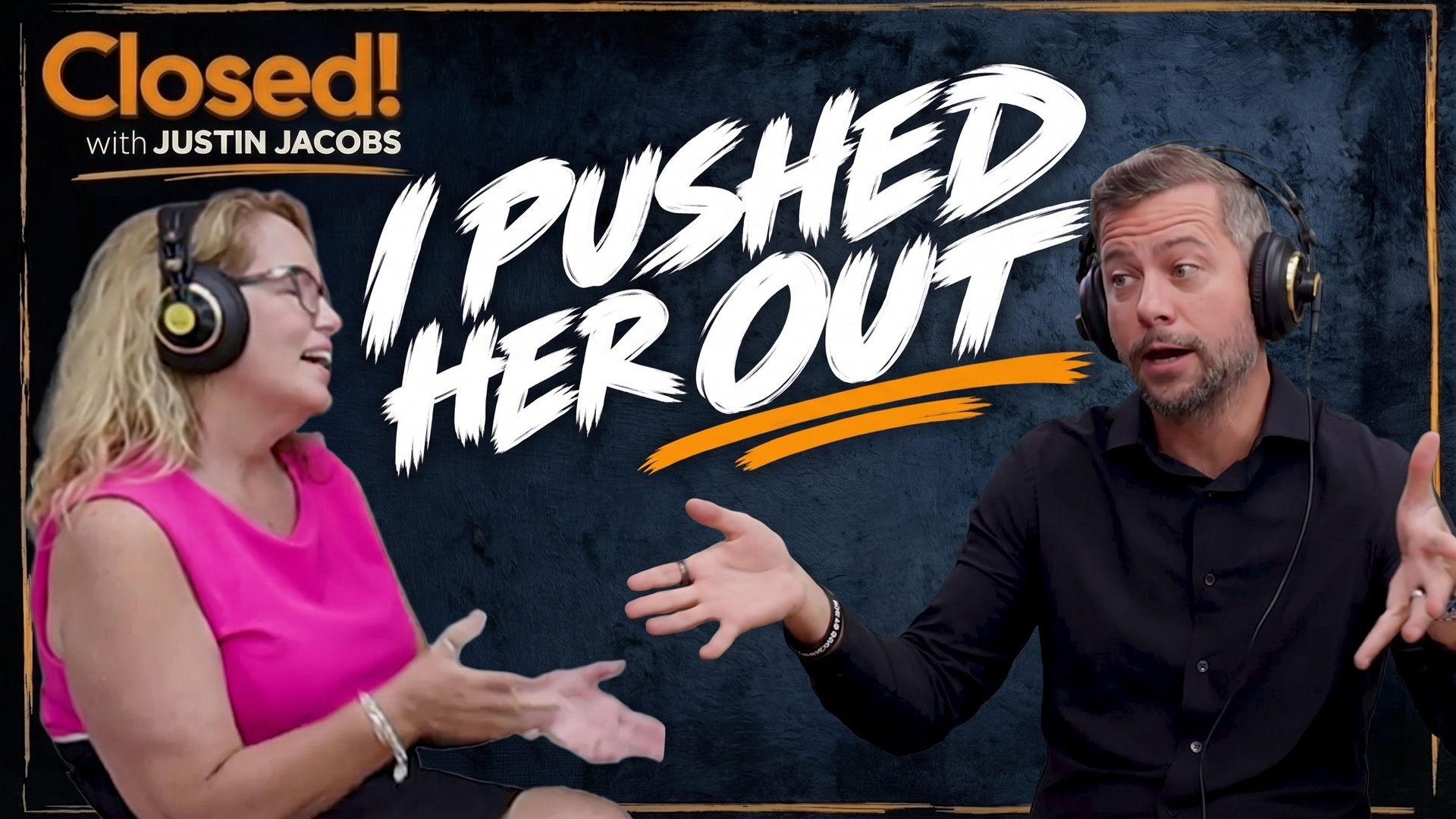
I pushedher out.
Romilda PierceOwner, Health Plan OptionsJustin’s protege
Romilda Pierce was a single mom and a grandmother, helping raise her grandson, when her call-center job ended on December 8th, right after AEP. She came to Justin to set appointments. A month before the next AEP, he took her off salary and told her to go sell.
There was no nest egg. She was terrified she didn’t know enough. Then it clicked: she didn’t have to know everything. She had to listen, and educate. Today she owns Health Plan Options and coaches agents of her own.
Watch on YouTube“Failure wasn’t an option.”
 Watch on YouTube ▶
Section 2 of 5 · Jump in anywhere
Chapters
Times from the final edit. The chapters on YouTube match them.
- 0:00Cold open
- 1:19Welcome to Closed
- 2:43Who she was before
- 7:24Learning to sell
- 11:12Pushed out of the nest
- 15:35The phone superpower
- 22:20Starting the agency
- 26:51Finding a mentor
- 32:46The Romilda challenge
Section 3 of 5 · The lesson
Six moves to steal
The whole episode, in the order you'd use it on a call.
- 1
You don't have to know everything.
Trying to memorize every plan cost her time and confidence. Three weeks into her first AEP it clicked: the summary of benefits has everything there. It's your friend, not a test.
- 2
You're not a salesman. You're an educator.
Her advice to new agents: say it to yourself before the call. You're guiding people to a decision, not pushing them into one.
- 3
Listen past the words.
Listen to the background noise. Is the TV on? Is a dog barking? Do they sound annoyed? Then meet them where they are.
- 4
Treat every caller like your parents.
She treats her clients the way she'd want her own parents or grandparents treated, so each one feels like the only person she's taking care of.
- 5
Put a smile on your face before you say a word.
People can hear it. She learned from an agent who wouldn't start a presentation until he got a smile or a laugh back.
- 6
Keep showing up for yourself.
What Justin saw in her. His two things a mentor can't teach: your attitude and your motivation.
“I try and treat all of my clients like I do my parents or my grandparents.”
Section 4 of 5 · Use it on your next call
The toolkit
Two sheets to print, the call rhythm, and a short strategy clip.
- Before you dialPut a smile on your face. Have the summary of benefits open.
- The first minuteListen to the room: the TV, the dog, the tone of voice. Don’t pitch yet.
- On the callExplain, don’t sell. You’re guiding them to their own decision.
- Every clientTreat them the way you’d want your own parents treated.
Section 5 of 5 · Every word
The transcript
A machine transcript of the conversation, lightly corrected.
Read the full conversation
There's a lot of people who say they want to work and that they're in to doing this job and they're going to give it 100% and then three weeks later after contracting has started and things are rolling, they're like, no, I'm going to have to stay at my regular job and keep this and I'm only going to be able to do this part time. Plenty of agents say they want to be coached. Romilda Pierce actually let it happen. She was my protege. Now she owns Health Plan Options and she can earn more trust in one phone call than most agents earn in a whole appointment.
Today we talk about what that really cost her. Romilda Pierce in the building. How are you? I'm good. How are you? You look fabtabulous. Thank you. As always. Yes. Thank you for doing this. You look very calm today. I'm trying. Remember one karate chop away from that mic. It'll escape from you. Awesome. Here we are. You ready to dive into this? We were just talking actually about how long we've known each other. Yeah. Almost 11, 12 years. Yeah. You're scaring me. Our anniversary is coming up soon.
Do we have an anniversary? We do. It's like April 11th or something like that. Wow. You remember that? I do. It's the day I changed my life. Wow. We're going to mark my calendar. Lee, I'm embarrassed. You ready for this? Yeah. Here we go. The obvious thing first is you are probably one of my first protege's ever. For me, it was kind of an accident because of our situation together, how it was presented. Help people that are watching this. Take us back to the beginning and who were you before you got into this mess with me?
Well, I was a single mom, grandmother, trying to help take care of my grandson. I had recently left a call center doing customer service for Humana and verification calls for Humana as well as my first AEP that I experienced was inbound sales for UnitedHealthcare. And as of December 8th, they dissolved the positions because they hire so many for AEP. And I was just trying to figure out what I was going to do. And I have a family member who was with her neighbor at the office, the old office on Powers.
Wasn't it like your mother-in-law? Yeah. And she said to you, you ought to meet my daughter-in-law and you called me and we talked a little bit on the phone and we set up an appointment. And that was it. That was all she wrote. It's funny because people do that a lot. Sometimes they're like, oh, yeah, you're, you know, you run a business and that's, yeah, okay. Well, I have somebody that can work for you. And I'm like, oh, here we go. So I didn't know what to expect and we needed somebody to help us with the appointments.
So after we were talking about your experience, it was just like, this is a home run. And I forgot about the Humana thing. That's interesting. Yeah, I did verification calls and cut the Humana customer service. So when we first started working together, what do you think was the first thing that you needed help with? Everything. Everything. All the above. Because I was from Inbound Sales and I didn't know the broker life. I didn't know what all that entailed. I was a clean slate and needed to learn and know everything.
Yeah, because you were doing mostly behind the scenes admin stuff, sales specifically. So you were like a fresh slate for us to work with. So everything, but actually, what was the thing that you really needed help with? Was there anything that stuck out in your mind? Not one specific thing because I didn't know what I didn't know. And so it was one of those things where I'm learning a whole new industry and I learned it from you. What do you think I saw in you that you didn't see it in yourself at that point?
You know, that's one of the questions that I wanted to ask you because I really don't know. I know for me, I just, I wanted to work. I had the, I was willing to learn. I was willing to be taught and failure wasn't an option. Yeah, I think that was part of the equation for me is, you know, back then we didn't, we weren't as structured with our company as we are now. So we hire against our core values, diamond reputation, fueled by purpose, a servant's heart, stronger together, inspiring mind shaping futures.
Those are our core values. And you obviously match all five, which made you a great team member back then. And I didn't know that until right now, just like reflecting back. I'm like, yeah, she's a core value fit, of course. But I think it was, it was that you kept showing up for yourself. And we had some bad days and you, and you got through them, and you kept showing up. And I was like, okay, she's got it. She's got the thing that's going to keep this, keep this thing going because everybody, it's easy when, when there's good days.
Super easy. Hey, I did six sales today. I had five appointments and closed all five, right? But the bad days when you had three appointments and you struck out on all three, you go home and you're like, I spent $80 on gas. Do I really want to do that? We really want to keep doing this. Yeah. So I think it was that, that motivation and that persistence that I saw in you specifically. Yeah. Were you looking for a mentor at that time? No, I think that just kind of happened.
But learning all this from the beginning and not really knowing what was right or what was wrong. Cause like I said, I didn't know what I didn't know. I was just this giant sponge willing to absorb everything. And when I heard your story and when I saw how you treated your other agents and your staff, I knew that there was something there that I respected and I wanted to learn from. And so I think it all came from there because I just, it felt right. I knew I was in the right spot.
Appreciate that. Looking back on that, how ready do you think you were to start in like, you know, sales? Cause I, well, that's the thing. I, I don't think I was really ready for sales, but once it clicked that I didn't have to ask for a check for Medicare at the end of the, at the end of the appointment, that I was more in the education business, that I was educating clients on their options and what they could do and, and open their eyes to the options that are out there.
That was when it clicked for me that this is what I want to do. Yeah. And that's what I was, was sharing with you in the beginning is like, Hey, don't purchase a sales approach it as education. You're just guiding them into a decision and they guide themselves right into that peg, whatever peg that they're looking for. You had said one of your first mistakes was trying to learn everything at once because this business, and even back then it's, it's less competitive or it was less competitive back then it is now.
And so there were, I mean, now you have even more options, but what did that look like when you were trying to learn everything at once? Chaos, mayhem, wasting time and energy. Even the confidence was not as, I wasn't as confident when I was trying to learn everything because I was so afraid that I was going to mess up and that I didn't know everything. But I'd say about, oh, three weeks into my first AEP, I finally, it registered to me that the summary of benefits had everything there.
And it was my friend and I wasn't alone. You know, and so when I realized that as long as I knew the extra stuff, the little things, the caveats that you, you know, you learn as you go on the way, once I remembered those things, knowing that that friend of the summary of benefits was there, that I could do it. And I didn't have to remember everything. And it was just crazy from there. Why do you think that's so tempting? And because you're not the first person to do that, we, I remember sitting in a room in a training and I said, this lady was, and I remember her name, Caroline, and she had been coming to the training for like four months, five months, no sales, no appointments.
And I'm like, what are you waiting for? She's like, well, I didn't, I don't have everything memorized yet. I'm like, memorize, what are you talking about? Like, oh, no, I'm trying to memorize all the summary of benefits. I'm like, are you crazy? Yeah, no. But why do you think like people tend to kind of... Well, because you want to come across as the authoritative person who's knowledgeable and knows everything. And once you realize that it's impossible, because one carrier offers 15 plans that you're not going to remember every plan detail, that's when it will get easier for you.
And you realize that you do know what's going on. And all your questions are going to be answered right there in that summary of benefits. And it's your guide. It's just about kind of knowing that pattern, right? Because like you said, it was standardized. It still is today. They're all standardized. You just have to know like, what are you looking for and what is it that's going to make that sale? What was costing you back then that you didn't realize it at that time? Confidence, power, knowledge, time.
I felt like I didn't have control. I didn't know what I was doing. Like I said, it was chaos. So when that finally clicks for you, it's like, oh, I know what I'm doing now. And you can move on from there. It's an exciting feeling. It is. It is. And I'm going to try not to be as emotional as I promised. We both promise each other this, but I remember you were in a really bad spot and you were really concerned about your cash flow. And you had a pretty steady job with us as an appointment center for our agents, but you had the license.
And I don't remember how or why, but I said, hey, AEP is coming up in a month and you got to go fly. You got to go out there and you got to go sell. And I saw the terror in your eyes because you knew, because I said, you're not going to get a salary. And I think it probably was a combination of us moving away from that position and then trying to figure out, and then you were just there. So I pushed you out of the nest.
You did. And then you're like, what do I do? And I said, okay, there's two products that are going to pay you fast. And you remember that. Oh, I remember exactly what you said. I remember exactly what you said. What was your reaction when I said, hey, go sell. And here's the two that are going to make you some money and they're going to make you money fast. Oh crap. Oh crap. I really have to do this. I really have to get out of the comfort of going from check to check and knowing that I have some income coming in to a huge leap of faith to being able to support myself and help out with my grandson while I'm doing this midstream.
And there was no nest egg. There was no nothing. So like I said, failure was not an option. But you sat me down and said, okay, this day, you're no longer getting a salary and you have to go sell, you have your license go sell. So I went from employee to broker. And it was, like I said, failure was not an option. You told me Humana and Care Plus would pay out first. And so you said, go get me some 11 ones, 12 ones, that'll get you some money coming in.
At that time, I wasn't even trying to count how many I was doing. I knew that the contest was there. But when that production went after those 10, 15 appointments, when it finally kicked in, that I didn't have to know everything, then my production skyrocketed. And I think I did like 60 enrollments my first AP for one one. That's amazing. Yeah. That's amazing. That's actually legendary because I think a lot of agents come in and they get scared, right? Same feeling. I was shaking in my boots.
Yeah, 100%. But then they kind of like give up on themselves halfway through. I see that a lot. And they'll come home with like 10, maybe 15. And then the money comes in in January and they're like, man, I should have worked harder. And you're like, really? So when did it click for you? Was there a moment or a call or an appointment where you're like, got it? I got it. And it just went. It was at an appointment for a husband and wife. And it's the story that I tell the wife wanted a supplement plan.
And the husband wanted an advantage plan. And I was going back and forth between that. I'm like, I just can't remember all this stuff. What is going to, you know, am I going to get the sale? Am I not? Am I going to get these people on a plan? And when it dawned on me while I was going over the PPO option of a humana plan for them, everything just kind of, it's like the light clicked and the sky's open. There is this just, because everything was right there.
And all the questions she was asking me were right there in the book. And I just assured her what was going on. And so the husband told the wife that if you go on a PPO plan and we save the money from the supplement premium, I will take you on a cruise. And so she did it and they go on a cruise every year now. Amazing. That's so cool. Yeah. Yeah. You owe him a Christmas card every year, right? He gets it. He gets it. He gets it.
He's like, wink. I often look for people that have superpowers. And one of your superpowers is being able to get people to trust you quickly which is our art form in itself. But also you can do it over the phone, which is even harder. Where does that come from? Well, I think my background in the medical field a little bit and then doing the customer service at the call center, you have to listen to people and not just listen to check a box or to just answer a question quickly.
You have to listen to the background noise, listen to their voice, see if the TV's on or if there's a dog barking, if they sound annoyed over the phone. And you have to listen to those things and be empathetic to their situation no matter what it is. And not everybody turns on that empathy at the beginning of a call and you have to. So is that one of the things that you look for in the first 30 seconds or is there something else that agents completely waste when it comes to that?
In my opinion, that's like you're in or out in 30 seconds. Well, they go in with the mindset, you're in or out in 30 seconds and you can't do that. You have to be in that servant's heart, the customer service mindset and they're calling you because they either A, want to know something, need something and they are calling you because you're supposed to be that resource for them. And so if you just do it to her, oh, I have another customer service call, another client who's bothering me, you can't do it that way.
I try and treat all of my clients like I do my parents or my grandparents. I want them to feel like they are the only person that I'm taking care of at that time. I love that. I love that. So you can't shake a hand over the phone. You can't read the room. What is it that you are reading on the phone? Their voice and them if they're annoyed on the phone, if they're upset, whatever it is, you take your cues from them and you use the empathy and try and solve their problems.
So is there any secret you might be able to share with people to identify some of those things? Because I'll be honest with you, I'm terrible at reading people sometimes. I'm like, oh, what? And if you've been married for five seconds, you can get yourself in trouble really quick. So me, it's a little bit harder and I always have this little disclaimer with people. I just want to let you know that sometimes I have a problem with understanding where you're coming from. So is there anything that you can teach with that?
Well, it's hard to teach empathy, but you have to turn it on. You have to have it. And to just listen, you have to actually stop and listen so they're heard and not just yes, no easy questions and brush them off. You have to be patient. A lot of people don't have patients on the phone. And when you're taking care of a senior, sometimes they're hard of hearing or whatever their situation. And they're not handy with cell phones. You have to think about what they're going through that prompted them to call and reach out to you for help.
Yeah. So we deal a lot with Medicare, obviously, seniors and things like that. The biggest thing is trust. What do you think makes a person on Medicare decide that the person on the other line is safe? The way you make them feel. Your response, your energy, your tone of voice, what you're saying, the meaning that it has, are they saying this like they're confident and that they're going to follow through with it? I try and reassure my clients on the phone that, okay, I'll walk you through the situation.
We'll call together whatever needs to be done and you assure them that you're their lifeline. So is there anything that you see agents do on the phone that they're just killing themselves doing? Yeah, the impatience. They don't have a phone etiquette or a phone, the empathy they're not listening. They're just trying to get through and solve a problem and move on to the next one. Yeah. Is that something you can teach them or is it something that they just got to have? I think it's 50-50.
I think it can be taught. Some of it, you can teach people to be patient. You can try and teach them to be patient. You can try and teach them to show a little bit more courtesy and empathy over the phone. But a lot of it you do have to have. For someone that's listening to this today and they want to get better on the phone, what's one thing that if you were like listening in, what would you tell them to do? Call centers have these whisper features.
If you've ever worked for a call center, it can scare the crap out of you because all of a sudden your manager comes on and it's like, shut up. What are you doing? Just close it. Right. First thing is, put a smile on your face before you ever say a word. I love that. Put a smile on your face because people can hear that. They can hear whether you're, oh, I'm Eeyore and I'm not going to talk very much today. I'm just going to let you do it.
Or there's, hey, how you doing? How can I help you? Oh, I love that. So there's a big difference and you have to do that. And then the other thing that I would do is have them say to themselves five times, I'm not a salesman. I'm an education. I'm not a salesman. I'm an education. And they have to understand that that if you go at it, yes, you have to always be closing. But if you go at it as a used car salesman, you're not going to get the connection and the comfort level for someone to enroll with you over the phone if you don't have those things.
Yeah. Going back to the smile thing, like that's an old school trick. Have a mirror at your desk kind of thing. I love that. And then I had a boss, and I might have told you this before, but I had a boss that he told me, he goes, I would never start the sales presentation. I wouldn't even start down that road until I got a smile or a laugh. So it was like a thing that he it was just ingrained in him on what he does.
Now, you had the great idea to start an agency. And I told you it was too soon. You did. Take me through that. And why did you think I was wrong? I don't necessarily think that you were wrong. I was doing a lot of the things that helping train new agents, because I was one of your senior agents. I helped Bill Cawthon and Liz. And when they both, after my helping them became Agent of the Year with top producers, I thought, well, hey, I can do this.
I can do this for myself as well and get my own batch of minions. I love that. You, however, I didn't think I was ready to do that, which I also had a partner. My husband now had the business sense and the background for us to do that and to doing it together is what's helped us become successful. What did you learn from going from independent agent to agency owner? What's like the big thing that you've learned in that transition, if you will? That you were correct, that it's like herding cats.
Oh, yeah. Yeah, 100%. What did you learn about yourself? My determination, more determination. It is a lengthy process and it is a lot of work. But I knew what I was signing up for, so I did it. But my determination is stronger than I thought it was at times. And I still appreciate that every day. I remember that conversation because you're like, I think I want to do this. And I'm like, all right, come on in and sit down because we're going to have a coming to Jesus moment.
Because it really was, it was like, you don't know what you're signing up for. And yeah, because it's kind of like I'm signing up for a job when I'm already working a job. And then you have to kind of balance those things until you can replace that job. So it's kind of like stacking two jobs at once. I know you were scared when you went out to sell. Were you scared when you started the agency? Or was it? Totally. Oh, really? Okay. Totally, totally. Was it like on the same spectrum or where were you on that?
I don't think it was as scary because I knew I had being a broker to back me up. And that's, you know, that's my failsafe always. So yeah, so it was scary. It still is scary at times, you know, recruiting is a scary thing. And it's not overly scary, but it's still one of the things that, you know, greats on you that you got to go find some more agents and let's do this. And you never know what you're going to get. That's true. So, you know, that's, that's one of the tricks and tips and things that I've even recently had some coaching by you and Sergio about and, you know, trying to find some sharks.
So yeah. From where you're sitting today, what do you think that you do better than me now? I don't necessarily think that I do better than you. I just think I do different than you. Okay. Okay. I learned all your training techniques and things like that. I do, I do the same. I even use some of your same little speeches and your little statements that you make, you know, one foot in the classroom and one foot in the field. And, you know, that they're not going to come walk into your door through the living room.
That actually came from Claire. So I'll give her credit for that one. And she's from, she's from Georgia. So the way that you say it is, they ain't going to walk through your living room. There you go. I remember that. Yeah. Yeah. But I do, I was focusing on, because I was green and I wanted to pay it forward the way you, the way you taught me and showed me, I was liking hiring and bringing on green agents. But it has come to my attention that that is a long game.
It's a long game. So I'm, I'm looking for a little bit of a short game now. Okay. Little bit. You kind of got to play both at the same time. I learned it. Yes, you do, you do. So for an agent that's listening and they are looking for a mentor, what do they need to bring to the table? The willingness to be taught. That's good. And willing to work. Yeah. There's a lot of people who say they want to work and that they're into doing this job and they want, they're going to give it a hundred percent.
And then three weeks later after contracting has started and things are rolling, they're like, no, I'm going to have to stay at my regular job and keep this. And I'm only going to be able to do this part time. Right. Yeah. Because they, once they stepped into that, they're like, oh, this is actually hard. Yeah. Yeah. I think the first hundred clients are the hardest in this business. But like once you get through that, it gets easier and easier. And, you know, from a recruiting perspective and even like in a hiring perspective, one of the things I've always learned is, and when I, I'll tell them, I'd say, I can teach you anything in this business.
I can teach you how to use a computer. Now I can teach you AI. I can teach you how to close. I can teach you how to recruit. I can teach you every angle of this business, but there's two things I can't teach you. I can't teach your attitude and I cannot teach motivation. Those are things that are ingrained in a person and they have to want it and they have to understand, hey, you can have an attitude like I'm going to lose or you can have an attitude that I'm going to win.
And that's a switch that no one else can, you know, flip on except for them. That's true. Yeah. So having that talk is important. And what's the fastest way to waste a mentor's time? Not being willing to learn and not taking advantage of the advice that they're giving you. Yeah. Yeah. I mean, you've got to show up. You've got to listen. You've got to be. You've got to want it. Coachable is what we say in this business. Coachable, you know, are they coachable? Are you somebody that's like, can you take it?
Because you'll roll up your sleeves and you're like, hey, you need to shift this and that. And they're like, I'm not doing that. I've done this for years. I've always done it this way. And they're not willing to shift to the left or right. Then you're going to have a problem on your hands. And that was one of the reasons why I like the green people. You know, green agents is because I'm green people. Why green agents is because they didn't have any of the bad habits.
They didn't know anything to, to have to correct. And I would like to train someone who doesn't have a bunch of bad habits to correct and thought it was easier, which it is easier, but it is a long game instead of the short game to get someone out there producing. So you're on this side of the fence now. You're developing people. You're developing your agents. What surprised you the most about being on this side of it? It's like herding cats. It's like herding cats. It's one of those things that you don't know what you don't know.
And until you know it. And then when you know it, you're like, oh, yeah, okay, I get it now. So, but it's a challenge. You know, there are challenges with trying to develop producing agents. And it is, it is a long game because you want to, you want to keep the quality of agents that once you get them all on board, you want to maintain that so that way you can build your agency. Right. And so finding the quality agent is the biggest trick. And that's one of those things that you have to, it's a constant evolution because the industry is changing.
You know, prior to COVID, we did everything on paper. And, you know, so now with being everything to do everything electronically, you've got to have people who are computer savvy, which a lot of the older agents, senior agents, they're struggling with sometimes. It's funny because that was the catalyst to move the business more towards the EAP systems. And I thank COVID for that. I do. I do too. I do too. Because the data, it's just faster. It's more accurate. The client gets their cards. It's just cleaner business all the way around.
And like it's hard to sell an agent on that. If you've been doing paper forever. So sometimes these things happen in the business where you're like, this is such a pain. But it turns out to be a blessing in disguise. It's like, okay, wow, look at how fast I'm able to do this. And, you know, that was a bit of feedback that I tried to share with agents about, you know, using these EAP systems of saying like, hey, look, what does your night look like usually?
And I can tell you what it was for me. I would come home with three, four, five apps and I'd spend the next hour, hour and a half processing, scrubbing them, calling back clients because I missed their, you know, I got their phone number wrong or I'm missing a digit. And then sitting there and faxing the apps in and waiting for that confirmation to come through. And I'm like, what am I doing? You know what I mean? So getting that time back is essential. And sometimes you have to have those hard conversations.
So question for you, what is it, what's the hardest part about telling somebody the truth about the business when they don't want to hear it? That's one of those things that, you know, you can only tell them and teach them the information that you have and present it to them. And if they don't want to hear it, that's an on them, not an on you. And that will let you know if they want to be mentored and learn from somebody who's trying to teach them the information so they're not struggling.
Yeah. All right. So we're towards our last question here already. So I want the Romilda challenge here. All right. So every agent that's listening right now, what do they need to do this week to get serious about getting better and not just talking about it, but actually doing it? They have to decide if they really want to work and they really want to do this. Hmm. They have to determine within themselves that this is what I want. This is the kind of life because this business can change your life.
It is, there are, there is life changing money out there that you can earn. And they have to get out of their comfort zone. Yeah. I mean, you're evidence of that. You know what I mean? You come in going from how am I going to make it next month to, I saw your beautiful new car in the parking lot here. And you're like, yeah, I need a little bit more space and doing some stuff and some chauffeuring now, right? Yeah. Yeah. Going from that to that in my mind, I'm just, I'm so proud of you of what you've done.
And now you've, like you said, paid it for it. And you're like taking on that role of being the mentor and saying, look, I did it. I know you can do it. So let's do it together. I think that's brilliant. So Romilda Pierce, thank you for being on the call. And thank you for probably being the most calm person on this call. Like, I feel so relaxed right now. I'm like, wow, I can do this for another hour. Oh, well, good. Thank you. I appreciate it because I'm over here a bundle of nerves.
Oh, no, no, you did great. And thank you. That's that phone thing I got going. I'm telling you, you nailed it. Awesome. Well, thank you. Well, thank you for being here and we appreciate you. Thank you. The best thing I ever did for Romilda was tell her the truth and then get out of her way. Some of it she took some of it she ignored and she was right to send this to somebody who's still waiting on permission. I'm Justin Jacobs. This is closed. You have a nice day.