S4 · E5 · Went live 10/6/26
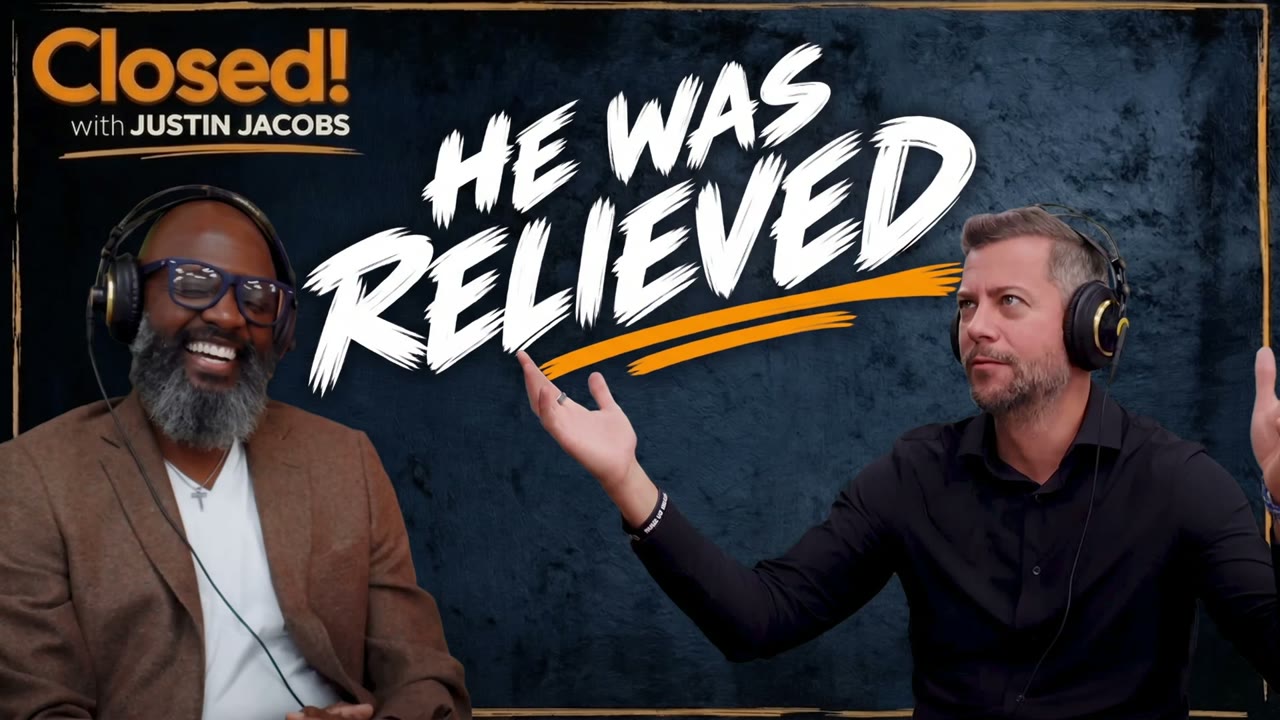
He wasrelieved.
Scorpio Lamonte MosleyMotivational speakerOut of the middle
Scorpio Lamonte Mosley spent years in Medicare sales, from the agent every senior center in Orlando already knew to leading sales teams of his own. When his role was eliminated, he had to stop himself from saying thank you. He felt relief. His wife took it hard.
He calls what he left chronic mediocrity: the middle, where things are fine and it still pays. Today he’s a motivational speaker, and he spends his time pulling people out of the middle.
Watch on YouTube“I literally felt a sense of relief.”
 Watch on YouTube ▶
Section 2 of 5 · Jump in anywhere
Chapters
Times from the final edit. The chapters on YouTube match them.
- 0:00Cold open
- 1:30Welcome to Closed
- 1:45Stuck in the middle
- 5:12Years in Medicare sales
- 12:55The day his role was eliminated
- 17:13His first keynote
- 20:49Hope vs faith
- 21:54Commitment before discipline
- 31:11Chronic mediocrity
- 36:02“I don’t have time”
- 40:39Short bursts, not 25%
- 45:55Finding your passion
- 49:34The fab five
- 51:08The Scorpio challenge
Section 3 of 5 · The lesson
Six moves to steal
The whole episode, in the order you'd use it this week.
- 1
Treat stability as the floor.
He calls it the trap of the middle: you made it from struggle, you found stability, and it starts to feel like the ceiling. “When it’s not the ceiling, it’s the floor. We’re supposed to build on top of that.”
- 2
Don’t blend in.
When he started, veterans told him not to produce too much, or they’d expect it all the time. Find the middle, blend in, no attention on you. He rebuked it.
- 3
Commit first. Discipline follows.
“If you commit long enough, you become disciplined.” He never set out to run 50 5Ks this year. He just asked, every week, whether he could get one in.
- 4
On the days you don’t feel it, scale it back.
Give yourself some grace, then ask how you can still get something done. A walk instead of a run still gets your steps in.
- 5
Short bursts at 100%.
Five streams at 25%, 20% and 17% each is just scrambling. Give one stream what it needs, let it marinate, then move to the next.
- 6
Line your tactics up with your strategy.
Most of us are great at strategy. The execution is on you. Ask who, not how: hand off what you shouldn’t be doing, and do the thing you love.
“You can’t master anything until you can master yourself.”
Section 4 of 5 · Use it this week
The toolkit
Two sheets to print, the weekly rhythm, and a short strategy clip.
- MondayPick one stream. That’s where your 100% goes this week.
- Every dayDo the tactic that lines up with the strategy. Hand off what someone else should do.
- A day you don’t feel itScale it back instead of skipping it. You can always do something.
- FridayCount it. Let it marinate, then pick the next stream.
Section 5 of 5 · Every word
The transcript
A machine transcript of the conversation, lightly corrected.
Read the full conversation
How do you execute short bursts to get this opportunity where it needs to be short, marinated at 100%? How do I figure that out to where I'm giving the best of me across those five lines of opportunity to get them to success? Because 25% is not gonna do it. 17% is not gonna do it, right? You're just scrambling. So I think that's the thing that I think a lot of agents can improve upon without doing anything different. Most agents aren't failing. That's the problem. They're doing fine.
And fine is the most dangerous place in this business. Scorpio Lamonte Mosley spent years captive with Humana before he broke out. He calls what he left chronic mediocrity and now he spends his time pulling people out of the middle. Let's talk about how you know you're stuck. And I am here with Scorpio. And I'm trying hard not to do it, but the Scorpio, which you just told me you hate, but I got to. So Scorpio Lamonte Mosley officially, your brand is Scorpio Lamonte. Did I get that right?
Yes. Awesome. That is exactly right. Welcome to closed. My pleasure. Pleasure being here. Thanks for inviting me. Absolutely. So a little bit of backstory. For me, we just met officially not too long ago, but I have known of you since I got my license in 2005 because you would be out doing your thing as an agent. And I would hear about this guy Scorpio, unless you have a twin with the same name. I was always haunted by this guy Scorpio because I would go to a senior center.
No, no, no Scorpio is here. I would go over here. No, no, no. We got a guy, his name is Scorpio. We're good. And I'm like, who the heck is this Scorpio guy that's got everybody locked down here in Orlando? So it was a pleasure to finally meet you. It's been a great relationship so far. So thank you for being here. My pleasure. My pleasure. And thank you for haunting me in my dreams. I appreciate that. It was a work, right? It had to be done.
All right. You ready for this? Let's do it. All right, man. So you recently came to our staff retreat and thank you for that. I think we got some great feedback. It's always great to hear from new voices that have been in the industry for a while. But you said something that really stuck with me and you said a lot of people are stuck in the middle. So what does that actually mean and how do you know you were there? It's funny because I think about just my journey and even like my introduction to the insurance industry, one of the things that a lot of the veterans that shared when I first came on board was they told me the story of, obviously if you don't produce, you're not going to produce.
But they also said if you produce too much, they're going to expect that all the time. So what you want to do is find yourself in the middle, right? You want to blend in. That way there's no attention on you. And to be honest, my background, where I came from, what I was trying to accomplish, I literally rebuked that. 100%. I rebuked it because I knew what I wanted to accomplish and I knew that this industry could provide it because I saw it as soon as I stepped into it.
But no disrespect to them. But it pointed me to an understanding that a lot of people are living in that middle space because it's comfortable, right? They made it from lack, they made it from struggle and they found stability. And stability feels like the floor, feels like the ceiling. And when it's not the ceiling, it's the floor. We're supposed to build on top of that. So for me, it's been something that started to resonate with me around that time. And I always took it with me.
I took it with me into leadership and now into this season that I'm in now, I see how rampant it is. And it's something that I definitely want to speak to and help people navigate through it because a lot of people don't even realize they're in it. It reminds me of the saying that Les Brown often uses is, a lot of people in life go through with their brakes on, right? What are you doing? It's like you get a new car and you have the emergency brake on and you realize you go three blocks with the thing on and you're like, oh, wait a minute.
I can go now. So it reminds me of that, which is really interesting. So you were at Humana for many years, take me back to those years. And what did you get out of that experience and that seat that you're grateful for today? Man, when I stepped into that opportunity with Humana, the thing that set out to me the most was the opportunity to advance because in my experience up to that point in corporate America, it was seniority driven, right? So whoever ever hear the longest, those are going to be the people that really make it to that next level.
But I saw the opportunity in this industry was if you put in the work, if you're good at what you do, if you impact people in a positive way, you can move into other opportunities, which for me was management, which was what I was seeking. So that was the biggest takeaway for me, just the opportunity to step into who I wanted to become in the industry. And that was just kind of the way that I started to kind of move with my day to day, week to week, month to month, year to year.
And it started to happen for me. You know what I mean? So that's kind of my biggest takeaway. I think beyond that is just the relationships, a lot of great relationships, and a lot of opportunity for me to what I feel like fulfill my purpose, which is building opportunities for people to transform from where they are to where they desire to be. Yeah. And you became a manager after many years of being in sales. And one of our managers here was one of your agents back in the day.
And he says that you were like an absolute awesome mentor and manager. So obviously, you were doing pretty good. And it seems like you were excelling, you went from sales agent to sales manager, you had a team. When did you realize that, okay, I've outgrown this, and now it's time to do something new? You know, it's funny, it's one of those situations where I think at times I can be too humble, I can be humble to a fault. And actually, it was told to me that I should be looking at the next level before I even considered it myself.
Interesting. Right? Because I was still preparing. I was still thinking there was more work to do. But it was told to me like, look, man, you're ready. Your presence, your impact, the way you move around people, the relationships that you build, you're there now. And knowing and having that come from people you respect, it's like, wait a second, let me think. Okay, all right. Well, maybe that is true. Because again, you're thinking there's more from yourself. But if other people are seeing it and they matter and they're decision makers, and they've been in this space longer than you, you got to respect their viewpoint.
So that's what kind of started pushing me down that path. And as I took a moment to look around and really see my impact, because it's not something that you just measure every day, every week or whatever, you don't really measure your impact, you're just living life according to your standard. But when I pause for a second and look at the respect that I get, the impact I've made on certain lives, it's like, you know what, that is like leadership. That is something I can start to move into directly, you know, in a position wise from a title perspective.
Because oftentimes you're a leader before you even get the title. I mean, I saw that in your book too. Thank you. But yeah, so that was one of the things that kind of pushed me forward, you know, just kind of hearing it from other people that I respect. So when you got that conversation, how long did you sit in that before you decided, okay, I'm ready? It wasn't very long. Okay. To me, I knew the work that I was putting in and I knew the eyes that were on me.
So when it was like, hey, bring me to the office, let's have a conversation. It was like, yeah, I knew it. I knew it, you know, because you could tell the impact you're having, you could tell how people respond to you. They promote you without telling you, hey, you should do this or hey, ask Scorpio to do that for us. You know what I mean? So it's like, I'm in it looking out for me. So you could tell that that was probably something that was on the way that conversation.
Was there any fear in making this decision to, and just to clarify, you're now a motivational speaker. You're a stylist, by the way, if you're not watching this, like this guy is, what did the kid say? He's drippy. Yeah. Like you're an inspiration for me on like how I need to step. I'm like, man, he always makes me feel like I need another level. So I love it. So yeah, tell me more about like what you're doing now and then, and then where was your mindset when you're like, okay, I'm going to do this thing.
I mean, I think when I look back over most of my life, there has been like this through line from day one where I've always felt like there's more that I could give. Initially, I think it was about how could I be more and then be better and do the things that I could do without holding back. But once I kind of stepped in to adulthood and early professional career, seeing the impact that you have on others, it became, man, I could be an inspiration. I could help that person go from where they are to where they desire to be.
If I only showed them what I do for myself, here's how my mindset, here's how I approach different situations. And the more I kind of catalog those opportunities, the more I realized like that's leadership. Without me even really going after leadership, I was leading just by being who I was. So that's why the jump to leadership wasn't really a jump. It's like, this is who you are. You already do that naturally. So now it's just you have a title to do it and now you have more of an opportunity to step into that space because it's your job now.
So I think that was kind of the journey of it all. And when I got the opportunity and I say it that way because when I was downsized or my role was eliminated, that gave me the opportunity to step into that fully. I did that throughout my career, leading people, but I had to do it on someone else's terms and I had to do it within the confines of what they wanted to accomplish. Now I could do that on Bridal with what I want to accomplish and the person that I'm leading wants to accomplish in themselves.
So that felt so much better than the creativity. Now I can do it in all the different ways. So to your point, when you think about speaking, life coaching, styling, all those things, there's a through line through all of them for me, which is confidence. And how do you show up? How do people perceive you? And you can impact that perception initially. Eventually you got to open your mouth and you got to start talking. You got to start acting and executing, but there's a way to set the bar very high.
And for me, when you set that bar high, now I got to execute in that same manner. And if I hold a standard, then I'll have the impact that I desire. Yeah. It reminds me of what happened to me also. I mean, sometimes you're like, I think I might do this thing. And then you're just kind of always thinking about the thing. Right. And then there's a catalyst. And for me, same thing. It was this. Anthem came in under the Wellpoint brand, bought Amerigroup, and they just said, we're done here.
And I was like, okay, I guess I am going to do the thing. But sometimes it takes something else to really... And by the way, it was the greatest thing that ever happened, right? For me, and I'm sure you're kind of feeling that now. But I know that fear, like that initial, like, holy smokes, what am I going to do? How am I going to do this? And I got to make money. And yeah, it's scary, right? Now, in that, in you trying to figure this thing out, and you obviously seeking feedback from trusted people, was there anyone that you deliberately didn't talk to about making a decision to go the route that you're going?
I keep my circle pretty tight, so I don't have to avoid many people, right? Because my circle is what it is. And a lot of times, I spend a lot of time reflecting, right? So a lot of my thoughts and my decisions are made through those times of reflection. I may have some folks that I trust, and I'll share it with them. But oftentimes, and this is just my belief system, I share it with my believer, and I kind of understand what I've been through, where I'm at at that point.
And then I make the decision, right? And then my decision is based on definitely previous experience, but it's also based on faith, right? So that faith leads me forward. And in that regard, I feel good about it. And it's never let me down, right? So I feel good about those situations, and I move on. And this transition was a similar process. As a matter of fact, to be honest, I probably had already made the decision in my head. So when the day came, when the word was given, I literally wanted to say thank you.
Like literally. And I had to prevent myself from actually blurting those words out, and I experienced the moment as you should. Okay, this is happening, and you ask the practical questions of what's next, blase, whatnot. But I literally felt a sense of relief. You know what I mean? It was like, yeah. And in that moment, I was feeling pretty good, and it wasn't until I told my wife, she's like, I was gonna say, how did she take it? She took it hard, man. And I'm like, man, you're making me feel bad.
Right, right. Because you felt good about it. I felt good about it. But she's freaking out. Yeah. And I get it. The stability, the life that we know, all that type stuff. It brought those feelings back. I'm human, you know what I mean? So you're thinking about that, and it's like, oh, man, I do gotta figure all that out. But it was one of those experiences where slowly, not immediately, but slowly, week by week, month by month, I started getting these confirmations, right? Talking to different people, different things will happen.
I tried to come back. I applied for positions that I thought I'd get, that I know I was qualified for. 100%. People that I had relationships with. I applied, and to this day, I don't know what happened. I'm like, that's strange. Interesting. You know what I mean? But as I look at the results of those situations, and I look at those confirmations, again, back to my faith, there's a reason why those situations played out that way. Yeah. You know what I mean? Yeah. Because I put myself back in the environment that I wasn't quite aligned with.
Right. You know what I mean? So I look at it from that perspective, and again, beyond that, more confirmations came, and through reflection and thinking about it, it's like, yeah, this is the path. It reminds me of the phrase, the universe conspires to help you. Yes. You know what I mean? Yes. So meaning, if you continue to think and meditate on it and ask God for it, and you really want it that bad, it just finds a way. It finds a way. You know what I mean?
So what surprised you in the first 90 days of making the jump from sales manager, captive agent, I mean, you could have gone independent, you probably could start your own agency, no doubt about it, you've got that leadership quality as well. Please don't. No, I'm just kidding. But you would kill it, right? Again, any direction in this business, you know enough to lead others to be very successful. So what did that first 90 days look like? Because you're coming out of an industry and into a brand new industry.
So what surprised you the most about that? As far as the process, it was really just being in alignment with who I felt I was purposed to be, right? And in the spring of 2024, I had a friend that needed some help with her event. She needed some help with an event she was planning, and she couldn't quite pin down a keynote, and one canceled, one was kind of wishy washy. So she turned to me, she's like, you should do it. I was like, nah, I don't think so.
Like, you're not serious, are you? Like, yes, I'm serious. So she stuck at it. And being a good friend, I was like, let me, I'll think about it. So again, as I'm reflecting, thinking, maybe I can do it. So women's conference, women's empowerment. I love my mom, single mother. But then I started thinking more. Single mother, the two households I lived between as a kid were my grandmothers. They led the household. Everybody knew who was in charge. The most impactful teachers, elementary, middle high school, were women.
They, in college, the ladies that really pushed me to transition from a student to adulthood and professional were two women. And into my early career, the best leaders I had were women. And I had four daughters. Wow, yeah. So it's like, who better to speak at a women's empowerment conference than me? Yeah, there you go. Been prepared for it my whole life. Yeah. So as I thought about that, I started to craft my message. And then it just occurred, like, man, I can honor my mother.
I can honor my sister's memory. You know what I mean? This will be great. So once I got the message in place, day of, I'm nervous as all hell, but I deliver it. Man, the tears, the hugs, the well wishes. It was like, oh my God, this is amazing. And it just had me floating for that next week, so much so that I wanted more of it. So I was already in different positions at different schools and things like that. I would go to schools, speak to students and things of that nature, just to get that feeling again to see if it's something I really could do.
And the more I did that, I realized, like, this has gotta be a part of my future somehow. Somehow it has to be a part of my future. So I was looking for ways to, like, I didn't know any professional speakers. So I was looking for ways, like, can you make money doing this? I knew the top ones, Les Brown and all the others, but it was like, can I do that? So I'm looking for ways to do that and all these little communities kept coming on your timeline.
And I found one, and this was around July of 2025. So I found one. I learned more about him. I'm contemplating, do I make this investment or not? And then August 15 comes, your downsides. It's like, hmm, I guess I'm gonna try it. And I tried it with the mindset of, okay, I can, I'll still get a job, but I'll try it to push myself forward in that space to see where it goes. And again, obviously the path we just talked about with the industry took place.
This was taking place simultaneously. So I'm growing there, stepping out over here. And eventually we just made the full leap into speaking. That's amazing. And now you talk about hope and conviction in your messaging, like they're built and not felt. So what's the difference in that? Yeah, I think almost hope is like a muscle, right? And you've got to build on it, right? You got to build on it. But what is hope? So for me, I look at hope and faith as two different things. So faith is almost like, it's very specific.
You know what it is that you're believing in, you know what it is that you desire, and you're going after that thing. You believe in it's gonna happen. Hope is almost like, I'm not sure what's gonna happen, but I'm gonna stay open. I'm gonna keep believing. And whatever comes through that door, I'm gonna grab hold to it. Right? And let that be the thing that takes me forward. So I think oftentimes, just having some measure of hope that something is coming your way. You don't know what it is.
You don't even know what you want. But you know that there's something that's gonna take you from where you are to where you're trying to go if you can just hold on to it. And stay patient, stay in the game long enough for it to arrive. Is there a difference between conviction and just being stubborn? Because I found myself in positions where I'm like, no, I really wanna do this thing. And it's like, no, stop doing that because you're terrible at it. Right. So have you crossed that before?
I mean, for me, I think I look at it a little differently. So I look at oftentimes there is this commitment and there's discipline. And commitment is almost like, what am I doing in this very moment? Can I do the thing that I need to do for today or tomorrow? Oftentimes people think that they're not disciplined and they can't be disciplined. Well, you gotta be committed first. If you commit long enough, you become disciplined. I think we start out trying to be disciplined. So here's the example I always give.
So let's like we talked about before we work out a lot. So I've been jogging like forever. Like I drive to Orlando and I see these places where I used to live. I'm like, man, I used to jog that path. But so this year I started jogging like I normally do. And for whatever reason, I started to look back in April and like March, April, like I wonder how many times, how many five Ks I've done. And I look back and I had done like 25.
I was like, that's cool. That's about 1.2 per week. So I was like, you know, obviously being competitive with yourself, how can I do more? So I was like, maybe if I kick it up a notch, see where I go. So by May, I was at like 1.6 at 37. And now I'm at 37 and I love like round numbers. So I'm like, man, I'm at 37. I wonder if I can do 50 before the year is out. Wow. So I hit it a little harder.
So that went to 1.8 and I looked and I was at 45. I was like, oh man, 50 is in sight. So that next week I was like, I'll bust out five for that week to hit the 50. I didn't hit five, hit three. And then the following week I hit the two. But I say all that to say I didn't start the year saying I was going to run 50 five Ks. Right. It would have never happened had I did that. Oh, yeah. I just committed.
Can I get a five K in this week? Okay, cool. Can I get a five K in this week? Cool. And then I looked up. Oh, wow. I'm getting a pretty high number. And now, so the way I look at it and the way I feel is, initially I was pulling the activity forward. I got to do it. I got to commit to it. I got to commit to it. But there was a turn in there somewhere. The activity started pulling me forward because now the number is 50.
And I have to do it. There's no negotiating. It has to get done. Right. So I think oftentimes if it's beneficial for you, you find ways to kind of incorporate it in your life. I know sometimes there's things we can be stubborn about and kind of don't want to let it go. But I look at situations like that when you're being stubborn. The sheer fact you're calling it stubborn is almost ego is involved. You know what I mean? So for me, it's like, how do I do the things, and this is what industry taught me.
How do you do the things that produce business results? We know what those things are. So if I do those, regardless if I like them or not, they produce the results. So this has nothing to do with my ego or rather I like the activity or not, it produces the results that I desire. So I got to do that. I got to figure that out. You know what I mean? So I tend to look at it from that perspective. If it's something that I just... And if it doesn't have that type of outcome for me, then from a stubbornness standpoint, I probably would let it go because it's probably not in line with what I'm trying to accomplish.
Or it's probably giving me a result that is more about me and what my ego as opposed to what it... As opposed to it benefiting me. I like the way that you, in your mind, you were like, you had a number, you looked at it, you're like, okay, I'm 25. But then you broke it down in a different way. You were looking at it like a weekly also, which helps reposition the goal a different way because you went from 1.2, I think it was, or 1.3.
1.2, 1.6, 1.8. 1.8. So you got all the way to 1.8. And so you're measuring it, the same thing in two different ways. And sometimes that helps shift that goal in your mind. I'll give you an example of that for me. I'm training myself right now and I have to do essentially 50 pushups, 50 sit-ups, 50 air squats every day. But you get to number 25 and you're out of gas. So then I started my mind, I started thinking about, okay, let me get five more after 25 and now I'm at 30.
And then let me get from 30 to 35 and oh, I only have 15 left. So I'm playing this math game in my mind. Yes, I love it. You know what I mean? You're only 15 away. Come on, boy. Let's get this going. You know what I mean? So that's really an amazing thing to do is kind of look at how that works. Now, there are days that we don't feel it. Right. So what do you do on those days? Give me some practices. Man, on days I don't feel it.
To be honest, I give myself some grace. It's okay. It's been plenty of days. Here's another thing I think, the same thing you just mentioned. So the process of doing the activity, and I think this is where the activity is pulling you forward now. So you're in the activity. You do your set, your circuit. But how can I do it even get a little bit more out of it? So I do the same thing with running. So my mindset is, man, don't walk. Don't ever walk.
Finish the race. So a lot of most days I finish it. But other days, I may walk last half mile of it. Other days I walk the entire thing, but I just don't count it. That's not a 5K because I walked it. But at least I got out there, got my steps in. So now I'm in this caloric deficit for the day still, even though I only walk. So when those thoughts come, but there's also days where I just don't do anything. You know what I mean?
So it's like, it is what it is. But just give yourself some grace. I think before you get to that point of when you don't feel it, how can you scale it back to still get something done? Because you can always do something. Oh, yeah. So even if I don't jog, I may ask my wife, hey, you want to walk around the neighborhood? Sure. So I get to chat with her and hear all of the things she has going on in the day. Two birds. But I also get my steps in.
There you go. Yeah, as guys were like, I'm here for the steps. But I'm like, exactly. No, it's amazing. And I love that. I've been fighting this cough that I've had. And so today, I did 50 pushups, but I did the junior pushups where you're on your knees. And so, but I still did it. You still did it. But it was like a half speed. So you got hope elevation. And it's part of what you've built. Who is that for? And then what's the kind of stuff that you're going after?
So, and this is the thing I had to learn in this industry, right? You can't beat all things to all people. I think my message resonates with all people. But who is your target audience? So right now, what I've done is, in order to just really build it from the ground up, my focus is on high school students. So why high school students? 9th, 10th, 11th grade. Why specifically those? So typically, you have the kids that know exactly what they're going to do. They know where they're going to college for.
Sure, yeah. So they all set. But the majority of them, they're lost, right? They're not sure what they're going to major in. They're not sure if they're going to go to school or not. I'm still trying to figure out what I want to do. That's what you're going to mean. So they're lost. But, and I think a big part of that is the identity, right? They don't know who they want to be. They know who they are. Social media is out there. So they're comparing themselves.
So they're really lost. So I think there's an opportunity to be able to pour into them, kind of help them understand what identity looks like. And the fact that your actions are a result of that identity that you hold near and dear to yourself. So based on, once they find out what that identity is, they can start moving how that identity moves, making decisions how that identity decides. And then from there, they can determine who they want to be at this next phase of life. Because they are stepping into a really important juncture in their life, which is right after high school.
That can determine their next 20, 30 years or so. I kind of drilled it down, baked it down to that specific demographic. But I think I can impact the entrepreneur, the midlife crisis. Because that's my life, right? I'm living through it. You know what I mean? We talked about how I got my start, women's empowerment. So I've been able to speak to women as well. So all those opportunities are out there. But in order to bake it down to who I can really impact and put marketing around it and start to get some momentum going, it's been the ninth, 10th, 11th grade high school students to be able to get them in a position to really make one of the biggest decisions of their life as far as the next steps after high school.
Yeah, I mean, it's a very influential group, right? In many ways, like you were expecting because of what's happening in our culture too. And you're working with these people in the middle. Do you find it's mostly men? I know you're working with everybody, but is it mostly the dudes that are just kind of like, they're in third gear. They know they've got a fourth, fifth, maybe even a sixth gear. But they're like, yeah, I'm just going to chill in this third gear. Like, who are you finding out there like that?
For men, it's, again, it's easier for me to speak and be to me because it's obviously what I know best. But to be honest, I don't even think it's the fact that they realize they're in third gear. I think it's a situation where we're in a space where, a lot of us are in a space where we wear a lot of different hats, right? So I'm a husband, I'm an employer, I'm a founder, I'm maybe a CEO, I'm a brother, I'm a son. A lot of us are caretakers for older parents and things like that.
So all those things, I think they end up pulling us in different directions. And what I feel is like it knocks us off our pivot, right? So over the years, now we've drifted a little bit because all these pressures are pulling us in different directions. And it'd be okay if they all pulled at the same amount of force at the same time. Yeah. But it underlakes, right? My kid may get in a car accident. So that pulls me more in that direction. My parents need me to figure out the medications that pulls me in that direction.
I got to deal with them and get them situated. So before long throughout life, we're not on that pivot that we're on. I'm all things to everyone else and I'm nothing to who I am. And I think that's the biggest issue right now. I've drifted and I've become this person that I look successful to everybody else. I look like I got it all together. But for whatever reason, when I'm looking at myself in the mirror, I'm like, damn. You know what I mean? Oh, yeah. That's hard.
And you can't let go of the rope on all those things that you're involved in. So now you got to figure out how do I get back to being me while still doing those things. Right. And that's incredibly hard to do, man. So I found that it's a process and it starts by turning your gaze inward and starting to do the tough work, answer those questions that you have about yourself. And then it's putting in the effort to figure it out because it's hard and it's not going to drift back.
It's not going to happen. You know what I mean? And I want to find people in that space, help them kind of figure it out and get back to being who they are, a purpose to be. You're attacking chronic mediocrity. That's it. Chronic mediocrity syndrome. Right. And so what does it look like from the outside? Because you're seeing this as they're coming in. Because like you said, it's not failure, right? You might feel like you're failing. Everybody else sees it as success, but you see it as chronic mediocrity.
So how do you identify that? You're like, dude, you're third gear. You got so much in the tank. Let's go. It's funny because I lived through it. Like I said, a lot of this stuff, a lot of my platform is my lived experience. So over the years, I would often get, man, there's something about you. You're bigger than this moment. You're bigger than what you're doing right now. And I'm like, man, what are you talking about? I'm a manager now? I'm a director? And I kind of knew what they were alluding to.
Because I kind of felt that myself, like I could be doing more. I should be doing more. And a part of me was like, but how? How can I? I don't know how. I got this stuff that I'm accountable for. And there's no time. There's no... You know what I mean? So I think it's one of those things where, you know, oftentimes we're in that space and we know that there's something else we want to be able to accomplish, but we just can't lay down all the things that we're accountable for right now.
So we stick to it and we just live our life accordingly. But for those that get a little taste of what it looks like to be able to possibly go after it. And that's what August 15th was for me last year. That was a little taste. It's a difficult situation, but this could give me the opportunity to go after what I've been searching for. And that was enough to tilt the scales. Yeah, the weight of everything I'm dealing with has kept me here. But man, just the opportunity to go after what I feel I'm destined to be and what I'm destined to accomplish.
Yeah, we got to go after that. And I think, given that chance, a lot of people will go after that. I think the biggest lie people tell themselves is I don't have enough time. You know what I mean? I hate that. And I love the quote by Peter Drucker. And he says, until you can learn to manage time, you can manage nothing else. And that's a big one that has really resonated with me recently. And so I've got systems now for time management and I protect it.
And nothing gets on my calendar until it goes through my assistant. And you get to a point where you're like, you start realizing how precious the time that you have is. Because like you said, you can't do everything. So you have to refocus. Hey, maybe my marriage isn't where I want it to be. So I've got to shift there to do that. Or maybe my finances aren't where they need to be. So I need to shift there a little bit or my family's not there or my fitness is not there.
You've got to figure out how to shift. And you're in that control mechanism. You're in the captain's chair. That's it. You get to pull that lever down. You get to push that lever up. And I think we get guilty a little bit of changing these levels a bit. You know what I mean? It's like, hey, I can't really do a date night this week because I really got to get some extra hours in because I'm trying to get to find it. You know what I mean?
And I think if we explain it ourselves, I think people will have more grace. 100%. That's just my, from what I'm taking from you. No, I get that. And I think, because to your point, I actually took, I don't have time out of my vocabulary. I love that. I can't even use that no more. Yeah, either you will make time or you won't. Right. That's it. It's a decision. Yeah, exactly. It's a decision. And I think we don't realize the power of our decisions. Mm-hmm. Like, the power of our decisions is, it's what got us where we are now.
So if you look back and understand that the decisions that I've made have gotten me here, regardless if it's a good place or a bad place. Right. That means my future is in the palm of my hands because my decisions will get me to where I want to go. Yeah. You know what I mean? So it's like, once I started to really grasp that, that's why for me, my gaze is always internal. Like, I get all the things that are going on outside of us. All those things are true and all those things are impactful.
You know, but along the way, you are making decisions. Yeah. Right. They say we make 35,000 decisions a day. Wow. 35,000 decisions a day. So you're constantly making decisions that are truly life and death. Yeah. Right. So if we tilt the scales to make more that are producing life, we change our life. Mm-hmm. That I mean, so I think that's the thing that we got to be aware of too because too many of us, you know, we blame the outside forces. It's this. 100%. You know, leading people and agents is like, oh man, the plan.
Oh man, the doctors. Oh yeah. Oh man. I see you guys do this. Yeah. And the chair is interesting to decide. Yeah, it's like. It's like, no, what about you? Can you do something different? 100% you can. Now you're still in our world. You're still in the Medicare world. I don't think anybody gets out alive by the way. That's real. The staying in it make you a better speaker or just harder to lie to, like what we were just talking about. I think it makes me much more aware of, you know, how can I have an impact?
Mm-hmm. Because I see being in it for so long and knowing the people, having their relationships, it gives you more clarity, much more clarity. Not that I wasn't clear before, but sometimes stepping back outside of the thing, stepping back from the forest to see the trees, you see it more clearly. Right. So I think it's definitely done that for me. You know, but the biggest thing though is just being able to kind of see the inner workings of it. And hear it from a perspective where I'm getting different perspectives from different people as well.
My career obviously was on the captive side. So I had just one perspective doing those timeframes, but now just being able to hear from different people and seeing how things flow throughout the year, it's been just more clarity more than anything. Yeah, you're a recovering insurance agent like me. So I know that, like stepping out of being in the sales, you're like, oh, don't do that. Do this. Yeah, of course, you know? But when you're in it, you wouldn't have listened to it. Come on, man.
100%. So outside of production, what do you want an agent to walk away with from listening to this today? I mean, I think one of the most important things is, and you keep referring to your book and I was kind of looking at that and kind of looking at the practical approach of it. The one chapter that really stood out for me was your iceberg. And that 90% is what's not seen. And that brought me back to the space of what are you doing that's going to allow for you to find more success.
So really, focusing on what does execution look like? Because here's what I found, right? We are amazing at building strategy. We build great strategy. We have the action plans. We know exactly what's going to work if I do this over here with this group and this over here. But what we feel that is the tactical aspect, right? The traction. Yes. So the tactical aspect is what actions am I going to take that are going to allow me to achieve my strategy, right? That's the execution. That's on you.
That's looking in the mirror. You know what I mean? So because what happens is I think a lot of agents will, they'll have the strategy and they got just say, for example, is five streams of opportunity. So I got these five streams of opportunity. I'm busy. I got it going. I'm going to devote 25% here, 20% there, 17 there. And we're going to find success. Right. All wrong. How do you execute short bursts to get this opportunity where it needs to be so it marinates at 100%?
Then I go to this next one. I give it what it needs, 100%. And let that marinate. I go to the next. You know what I mean? How do I figure that out to where I'm giving the best of me across those five lines of opportunity to get them to success? Because 25% is not going to do it. 17% is not going to do it, right? You're just scrambling. Right. You know what I mean? So I think that's the thing that I think a lot of agents can improve upon without doing anything different, right?
Going in and making new relationships and no, no, no. To be more impactful with nothing different than what you already have is look at how your tactics are aligning with your strategy. Yeah, I love that. It's for me, it's, it came naturally because I obsess about things. I'm like, oh no, I got to crack the code on this. Like the first time somebody gave me a Rubik's Cube, I was like sitting in my room for like, like days, like, no, no, no, I got to figure this thing out.
I was obsessed with it. So I know that about myself, but sometimes it just doesn't work for that person or they lose passion for it. So they're ready to step into a new role or maybe they're stuck. For somebody that's sitting in like, quote unquote, the wrong seat right now, what's the first honest thing that they really have to come to terms with? What are they passionate about? What's important to them? Because you can't master anything until you can master yourself. Like, how do I master myself?
And if you, to master yourself, you got to first know yourself, right? Before I can start to master myself. But what's important to me, what am I passionate about? Like for me, as an agent and as a leader, the most important thing was relationships. I didn't come into sales as a salesperson. I came into sales because I obviously had a background in education and I like building relationships. So I used that to my benefit, right? To your point, I was everywhere. And I mean, because the relationships weren't important.
And I knew if I wasn't there building a relationship, somebody else was. You know what I mean? I was just waiting. I was waiting. Exactly. So I was like, I got to keep these relationships fire. Because I don't want anybody coming in and taking my relationship. So yeah, I think that's the key, right? Figuring out what is it for you? What's your thing? And let that be the thing that kind of carries you forward. The other thing though, I'll say too, is this other book I'm reading, was it Dan Sullivan?
Who Not How? Everybody knows how things are done, right? But should you be the one that's doing it, right? Can you outsource some of the things that are important for you? Obviously, in this day and age, we can outsource a lot of things. A lot. You know what I mean? Figuring out, okay, what can I outsource? So we get that done at its highest level. So now it's not done by me at its very minimal level. And I do the thing that I love doing. So that's going to, number one, gives me a lot more energy, more excitement about doing the job that I'm doing.
And we get more efficient. And we make more money. You win it all the way around. You know what I mean? So I think those things are the key to really kind of figuring out how do I make a change with where I'm at either more production or more impact in the role I'm in or ascending to another role that I want to be in. Yeah, it's interesting that you say that because I've driven my career in that fashion of, hey, I'm really passionate about helping seniors and I would go and I would do sales.
And then I kind of lost a little bit of that passion. And then it turned into, oh, I'm really passionate about teaching agents on how to do that business because I was there. So I would do that. And then I was like, okay, I don't know if I want to do that. Then it was about agency owners and like, okay, this is how you run your business. And like, so even if it's in the same role, you can find different passion within it. And it's one of our core values is fueled by purpose because you have to find it.
And if you're not feeling it anymore, really reflect on like, and one of the questions I ask our agents is on your perfect day, your absolute perfect day, walk me through what that looks like. I wake up and I've got a 10 o'clock seminar and the room's packed and I do 10 sales. And then I go to the beach and I'm like, okay, that's cool. How do we get you there? How do we get there? Right. Reverse engineer. Oh, yeah. And then they'll tell me, I'm terrified of public speaking.
I'm like, okay, maybe let's back up a little bit on that first. But pulling that out of them, I think is so important. And moving into new passions, what's the biggest mistake that you see people make? Again, not knowing truly what they're passionate about. Just because someone else is passionate about something else doesn't mean you're going to be passionate about it. I think one of the things that points you in that direction is oftentimes when people are kind of strapped for trying to make money. And if they're so focused on trying to make money, everything looks like a great idea.
Everything looks like, okay, if you're passionate about that and you're making money, I need to do that. Right. Right? And social media is doing a crazy job of forcing them to have us think that way. And that's why a lot of people end up failing because you're not passionate about that. Why are you trying to do it? Because someone else is making money with it. It's not your thing. You know what I mean? So what are you passionate about? And find those people, if it's that important that you make money and see people making money doing that thing, find those people.
They're out there somewhere, but find those that are doing the thing that you're passionate about. But you first got to figure out who am I? Yeah. What makes me want to leap up out of bed? You know what I mean? Yep. That thing, whatever that thing is, okay, now if you have to see someone making money doing it, but oftentimes you probably won't see that either. You got to fall in love with it, figure out how you're going to do it, and the money is going to come because you're exceptional at it.
And again, I'm walking that journey now. You know what I mean? So definitely being in this space is provision in that regard because you feel so much better about it, but with anything. If you get great enough, you become the expert at it. Obviously, the money is going to come. So yeah. It reminds me of what's happening with AI right now. In a lot of ways, I felt that us humans were kind of stuck with what we know, our network, and then the passion too a bit.
But AI kind of feels like you were in a cage for 30 years, and then they just opened it. And you're in a field, and you can go anywhere you want now. And I think people are still stuck with like, they come back to the cage. It's like the bird at the canary. For 30 years, it lived in the cage. You open it up, it flies out, and it flies right back in. So I think there's that happening in people's minds, and it's exasperated because of social media.
It's like, oh, look at all the cool stuff you can do now. But really, it's like multiple people finding a path and saying, you know what? I'm really passionate about how to cook a really good steak. And so it's interesting if you do an audit of what you follow, you know what I mean? Okay, you like making steak. Okay, get real good at it. Like get real good at it, and just keep doing that thing. And that's how you become a professional. That's how you become a motivational speaker, and a stylist, and the things that you find in yourself, the passion.
Because I'm sure you're living your best life right now. I mean, versus- It feels good. It feels good. It's funny because I think about, I share this with people, like my five anchors, right? These are my fab five I call them. And it's faith, family, fitness, finance, and fashion. Ooh. Right? I'm going to add that fashion one. I like that. Yeah, yeah, yeah. So you'll find those as a part of my day, all of them, some of them, or at least one of them, every single day.
Those are my anchors. I love that. Well, you got fashion. I mean, you're just showing up, man. Those are my anchors, right? So what are your anchors? Yeah. Like, right? What grounds you, regardless of your title, regardless of your job, or anything else, what grounds you? I love that. Those are the things that grounds me. Yeah, well, I'll tell you what, we share four out of the five, but I'm adding that five, so we're going to be fully aligned on this. Gotcha. I would say just from personal experience, a couple years ago, I went through an experience, I'm going to share that with you later, but my faith and my family was not there.
My fitness and finance was there, which with guys, that's where our control comes from, right? Right. The other things you don't have control over, so I drifted from those things. When I started putting these things back in alignment, my life took off, things started changing. I started showing up different to the point that people were like, what happened to you? Yes. You know what I mean? So that alignment of core values and how you're balancing your life is so important. I'm really glad you brought that up because we're very much aligned on that.
We're to our last question, brother. Oh, man. All right, here we are. So I want the Scorpio challenge here. All right, the Scorpio challenge, for those that are listening, what does the person sitting on this decision to move into something else or take that leap of faith and go do the thing that they're most passionate about? What do they have to do this week to move in that direction? I think the most important thing for that decision to be made is number one, start with some reflection, right?
Reflect on just reflect, reflect, right? Because I think if you do that right, and if you don't know how to reflect, start with three minutes. Just three minutes, pausing and just thinking. You could put some background music on if you want, but just start by reflecting. Three minutes. Once you make it to three minutes, push it to five minutes. Once you make it to five, push it to 10. And the reason I'm saying that is because it's far too much clutter in our lives right now.
Yeah, yeah. Right? It's way too much clutter, right? You're thinking about your phone, you're thinking about your appointment, next appointment, you're thinking about all these things. And you never stop to think. It's crazy. You never stop to think. Like we are wired to keep moving every day. And that feels like accomplishment. It does. It's dangerous. And it reminds me of something that I read recently. It says, in this time that we live in right now, it is the easiest time in history to become a millionaire.
The easiest time in history to become a millionaire. However, in this time that we're living in right now, this is the hardest time to stay focused. It's the most distracted we've ever been in the history of the world. There you go. So you saying these things and like sitting down reflecting, truly finding those focus points, and finding yourself, finding that passion, and then moving in that direction. I think that's the best advice I've heard in a long time. Because often what we do, we instantly we decide and we're off and running.
Usually chasing the dog. It's just nonstop, nonstop. Yeah. Pause. Pause. Take a breath. Declutter your mind. Declutter your mind. And let those thoughts that you probably hadn't had in a very long time, take over for a little bit and let that be your guide. And one thing that I'll say is find a mentor, find a coach. Oh, God, yeah. You know, Scorpio's info is going to be in the description. You can click on that. You can reach out because having somebody to talk this through, if you're like totally lost, you really should lean on somebody that can guide you and do those things.
So you haven't met him. I have a few. I have a few, but I'm always looking for another one, especially right now. One that's drippy. I need some drip in my life. I wasn't telling myself. I was just proving the point. Like someone is accomplishing you. No, no, I'm sold. Having a mentor. Of course. Of course. Yeah, that's what I'm saying. The greatest players in history until the last day always had a coach. Yes. And even their coach had a coach, right? So you have to, I like the chain effect is like when you're coming up, somebody's pulling you up or helping you, but you can't forget about the chain, meaning like you got to also mentor someone else as well.
So I'm stepping more into a mentor role as well as being mentored on those things. But yeah, if you don't have a mentor, I think that's what you're alluding to. You need to find a mentor. Got to have one. No one is in a position where they don't need a mentor. There's someone that's always a level above you that has the experiences that you're going through that can pour into you. Jeff Bezos, Tony Robbins, Elon Musk, they all have mentors and they all still work with their coaches and things like that because there's things that you got to work through.
So get yourself a Scorpio. Get your Scorpio from here. Also, shoot me that you can find me. And we got you. So if you want to mention your website or how can they reach out to you? So I'm on all social media platforms, the Scorpio Lamonte website, ScorpioLamonte.com. And here soon in the fall, got the book coming. Yes. The book coming this fall. So be on the lookout for the hope decision, confronting chronic mediocrity and the fight to find purpose. I love that. I love that, man.
So proud of you. And you made it out alive. You're probably one of a million that did it. So we're really excited to read the book. Scorpio, thank you very much for being on this podcast. And thank you for looking as good as you do, as well as how you sound and the work that you're doing out there. Thank you. Thank you, brother. Pleasure. Nobody drifts into greatness. You drift into the middle and then you stay there because it's comfortable and it still pays. Scorpio got out and he'd tell you it cost him something.
If that discomfort you're feeling right now has a name, this episode was for you. Subscribe, leave a comment, and send it to somebody who needs it. I'm Justin Jacobs. This is closed. You have a nice day.